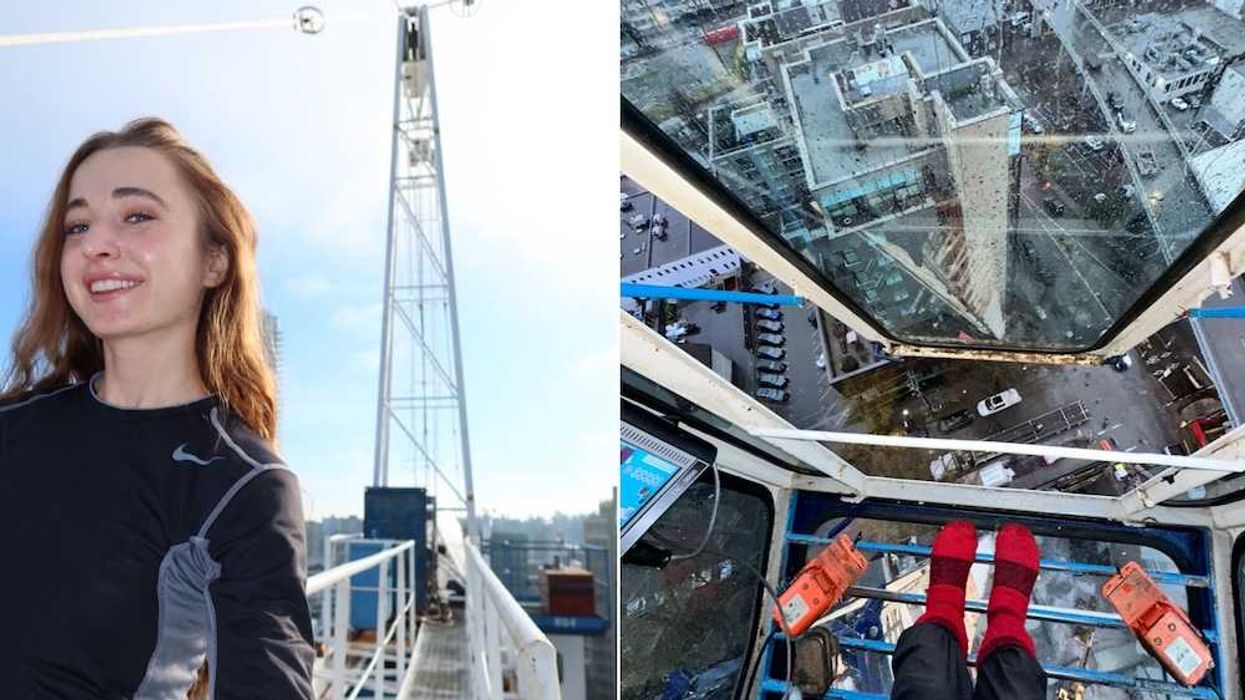
Women make up roughly 15% of Canada's construction workforce—a figure that's gradually improving but still reflects significant underrepresentation. Within that already small percentage, crane operators who are women are even rarer: approximately 1 in 25, or just 4% of the profession.
Manuela Preis is part of that 4%.
Born in Germany, Preis immigrated to Manitoba with her family when she was about 8 years old. After a year of university in Winnipeg, she relocated to British Columbia four years ago. Now 25, she's been operating tower cranes for more than two years and has built a following on Instagram by documenting the realities of her work.
In recognition of Women In Construction Week and International Women's Day, STOREYS spoke with Preis about her unconventional career path and what it's really like to operate a crane.
Responses have been lightly edited for length and clarity.
How did you get into construction?
I kind of stumbled into it. I was studying accounting at university, but when COVID hit and everything moved online, I struggled with remote learning. I decided to take a break.
A friend's dad was a foreman in oil and gas, and a few of us decided to give it a shot to make some money. It was supposed to be temporary, but I genuinely enjoyed it. The pay was good—that definitely hooks you—but there was also steady work. They didn't shut down during COVID, so it felt like a secure option.
How did you transition from oil and gas to crane operation?
I worked in oil and gas for three years and started operating equipment. Eventually, I wanted a change. The work was up north and out of town, and I was ready for city life. A friend who knew I was in the trades connected me with someone who had just started a crane company. He'd taught his two daughters to operate cranes, and they'd launched a training program for others.
I called him repeatedly until he agreed to meet me. I drove out to Vancouver, we had coffee, and I started the training process. That's how I ended up in cranes. [She details the story further in this video.]
What does the training process involve?
The regulations for tower crane operators are currently changing. When I started, the hour requirements were lower than they are now.
Basically, you work under supervision, earn your B Ticket, gain rigging experience, and then log hours in the crane with an experienced operator overseeing you. That's the path I followed.
Do you typically work on one project from start to finish?
Not always. Sometimes you do, but projects can be unpredictable. I was on one that got put on hold due to a disagreement between parties. You just never know.
My company keeps me busy and moves me around until they find a more permanent placement. But if you take time off—say, a couple of months—someone else takes over your spot, so you might not see that building through to completion. If everything goes smoothly and you stay on, you can work a project from beginning to end.
Your experience level also matters. For example, flying tables requires a Red Seal certification.
How would you describe the role of a crane operator?
It's mentally demanding, which I love. I like keeping my brain busy. You're monitoring multiple things simultaneously.
To me, it's almost an art form. You're managing a pendulum—this long hoist line you're constantly trying to control. You've got your trolley, different gears, and you're executing multiple motions at once: hoisting the load, trolleying out, swinging. The goal is to keep the load steady, move smoothly, and stay efficient.
At the same time, you're watching everyone on the ground, tracking what you're flying over, and communicating with your rigger and other equipment operators. There's a lot happening at once.
The role carries more responsibility than people realize. There's a technique to keeping loads smooth and maneuvering into tight spaces while ensuring everyone below feels safe. That's really important to me—I want the crew working under me to trust that I'm operating safely.
I wasn't aware of how complex the job is until I saw your videos.
It is complex. Your rigger handles the rigging, but the operator is also responsible for checking it from above. If something looks wrong with the rigging or the load doesn't feel safe, the operator has the final say. We work as a team.
You also need to understand load capacities—how far out on the jib you can extend with a given weight. Some cranes display the load weight, but many older models don't have indicators. You calculate it yourself based on the known weight of the materials. There are a lot of moving parts. [She explains crane capacities in more detail in this video.]
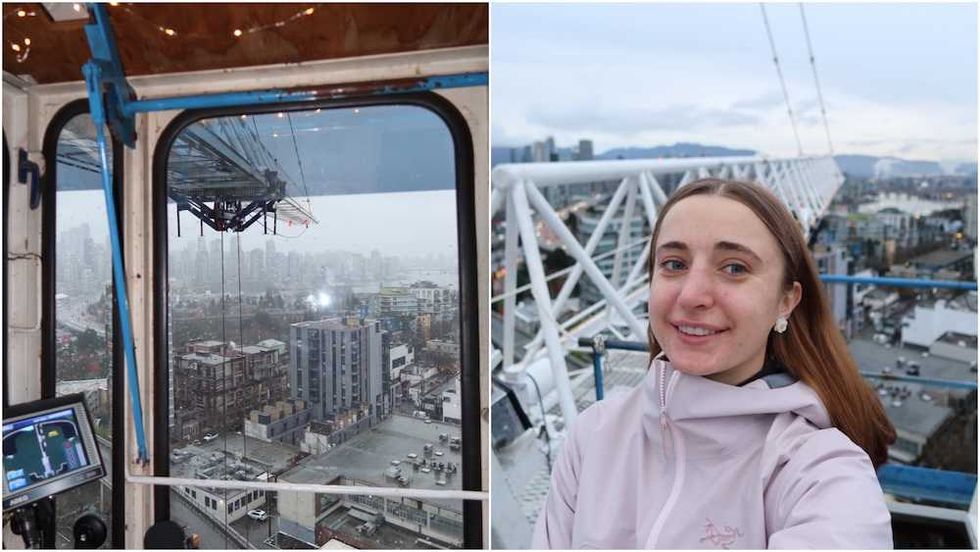 Manuela Preis/Instagram
What does a typical day look like? How much time do you spend in the crane? Can you leave?
It depends on the site. Smaller jobs might run eight or nine hours. On other sites, you never really know when you're getting off. You'll have an estimate, then suddenly you're there three more hours—maybe waiting on concrete trucks or finishing a task to stay on schedule. I don't make many weekday plans. If I get off early, I'll make plans on the spot.
I have climbed down mid-shift before—rushing to squeeze in an appointment, taking an Uber, then climbing back up. Sometimes you'll come down to grab a snack or stretch your legs, but most of the time I stay in the cab.
One thing I haven't shown on Instagram yet: when a food truck comes by or my rigger goes to 7-Eleven, I'll radio down my order. I have a bucket on a rope that I lower from the counter-jib. They load it up, and I pull it back up. No need to climb down.
How long does the climb take?
It depends on the crane's height. A really tall crane can take half an hour. Others are about 15 minutes. You're also doing your checks as you climb—inspecting each tower section, checking bolts, performing your structural inspection. You want to take your time to make sure the crane is structurally sound and all the bolts are secure.
So you're in the cab all day? Your videos show you packing food and even using the bathroom up there?
Yes, everything happens in the cab.
[The bathroom question is the most common one she receives, so she made a video addressing it.]
How does weather, particularly wind, affect your work?
We're required to shut down at 50 km/h winds. At higher gusts, the swing brakes might not hold the crane, which is extremely dangerous. If you're hoisting a load and the wind catches you, it can swing the crane without you being able to counter it or lock the brakes. Beyond 50 km/h, the wind is strong enough to overpower the braking system.
We have an anemometer in the cab, so I always know the wind speed. When it gets too windy, I notify the crew and we wait it out.
You're the one who makes that call?
Yes, it's the operator's responsibility. When you're up there swinging against the wind, it's harder to operate. At 50 km/h, it becomes very difficult to keep everything steady and functioning properly. You have to call it.
How often do you encounter other women in construction, particularly in crane operation?
It's very rare. The company I trained with happened to have two daughters who taught crane operation, but that's unusual. Even in oil and gas, I was always the only woman. It's normal for me—it's never bothered me. I grew up with five brothers, so being around guys has always been my reality. Going into construction wasn't a shock.
Most of the men I work with are significantly older. I was 20 when I started, and the next-youngest person would be 35—which was considered young in the oil field.
Even now, it's hard to find people my age on site, and you rarely see women.
What's your favorite part of the job? What keeps you coming back?
I genuinely love going to work. I really enjoy operating cranes. I know that's not how most people feel about their jobs, but I've never felt this way before. I'm passionate about it. The work is serious, there's a lot of accountability, and I like that. I like being held responsible and having that level of authority. At the same time, it's also fun.
You feel like a magician in a way. You're handling this load with extreme care, monitoring so many variables at once. You're chatting with the crew on the radio, joking around, communicating in different ways. You meet great characters. Every job brings really awesome people.